WH‑380‑F, certifying for a family member
Sound familiar? Your patient’s visit is ending when her daughter pulls out a WH-380-F and asks if you can fill it out now. The daughter is the one asking her employer for time off; the form is about her mother’s condition and the amount of time her care requires. Your clinic is running behind, and if the form is filled out incorrectly, the daughter’s leave may not be approved.
- Form
- WH-380-F, Certification of Health Care Provider for Family Member’s Serious Health Condition
- Issued by
- U.S. Department of Labor, Wage and Hour Division
- Revision
- June 2020
- OMB control number
- 1235-0003, expiry printed as 6/30/2026
- Your patient
- the family member who is ill, not the employee
- Return to
- the patient, never the Department of Labor
Key points
- Three people are on this form: the employee who wants time off, your patient who is ill, and you. Section II is the employee’s; if it arrives blank, leave it blank. Your part is Section III, from the green bar on page 2 to your signature on page 4.
- If the form arrives with no word about why the leave is needed, have your front desk book a visit with your patient within a couple of days rather than guessing from an old note. The employee’s 15 days to return the form are already running.
- The item numbers don’t match the WH-380-E. The six kinds of condition are item 5 here, not item 3, and time off in episodes is item 10, not item 9.
- Item 4 is the box this form exists for. Describe the care your patient needs (help bathing, a ride to therapy, someone watching for falls), not the diagnosis.
- Item 10, time off in episodes: write how often and how long each time. One number without the other often gets the form sent back.
- Certify your patient’s condition. Do not describe anyone else in the family, and do not write anything genetic.
- There is no Part C as found on the form WH-380-E. Nobody is asking whether the employee can do their job.
Before you start: three people, one form
The WH-380-F is the Department of Labor’s form for an employee who needs time off to look after a family member who is ill. On the WH-380-E the patient and the employee are the same person. Here they are not, and almost every difference between the two forms comes from that one fact.
The employee is the person who works somewhere, wants time off, and brought you the form. You may never meet them. The patient is your patient, the one who is ill; their condition is what the form is about, and they are not the one asking an employer for anything. You certify the patient’s condition and the care that patient needs. That is the whole job.
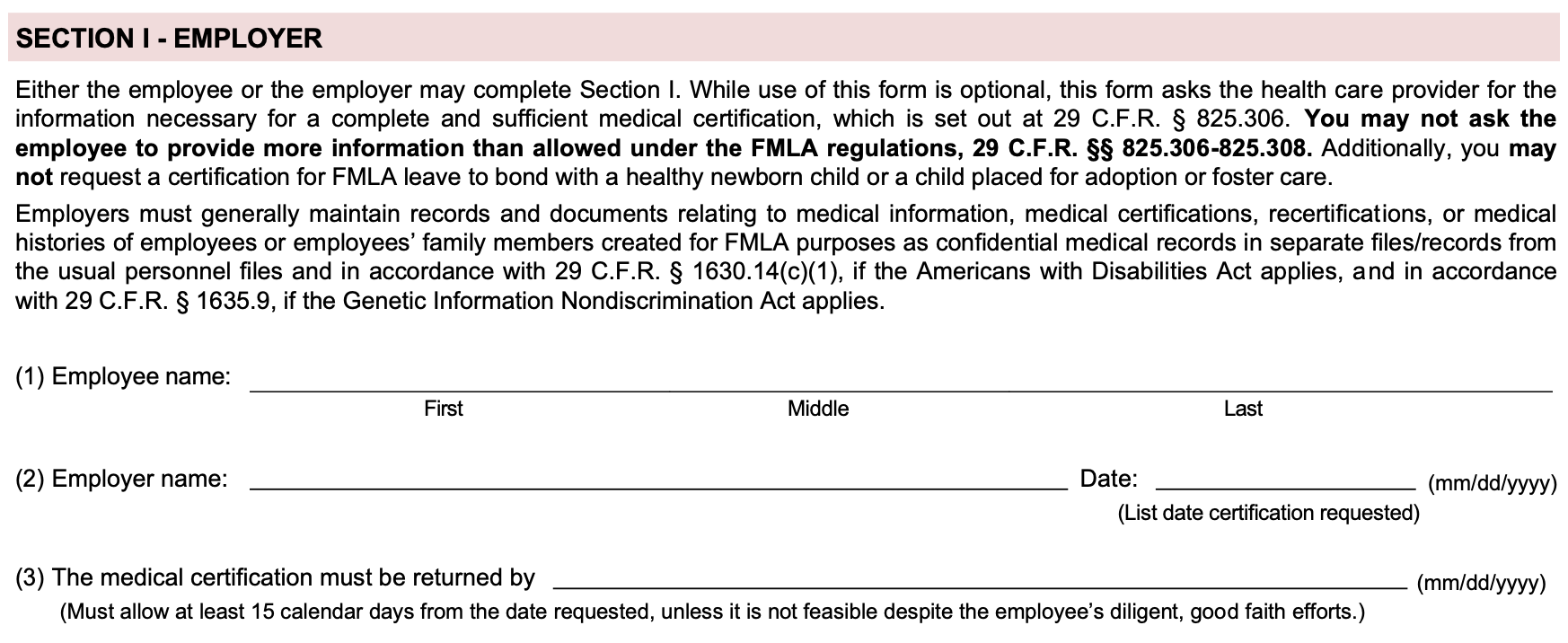
Four pages, three sections. Section I on page 1 is the employer’s, and it carries no job title, hours or job description, because whether the employee can do their job is not the question here. Section II belongs to the employee and runs from page 1 onto page 2, ending with their signature. Section III is yours: it starts at the green bar partway down page 2 and runs to your signature on page 4.
Once Human Resources (HR) asks for the form, the employee has 15 days to hand it in. If HR finds an answer missing or too vague, the form won’t be accepted and it comes back with seven days to correct it. A corrected form that still falls short can end with the leave denied. A returned form is harmful in several ways: it takes more time for the daughter to deal with, it takes more of your time for a second pass, and at worst it could cost her the leave.
When both of them are your patients. Sometimes you care for the mother and the daughter. The question to ask is whose condition is keeping the daughter from work. If she needs time off to care for her mother, that is this form, the WH-380-F, and it is about her mother’s condition. If the daughter herself becomes ill, say she is depressed from the strain of caregiving and is missing work because of her own symptoms, that is a separate form, the WH-380-E, about her own condition, filled out at her own visit. Keep the two apart: nothing about the daughter’s health goes on her mother’s form, and nothing about the mother’s health goes on the daughter’s. Both kinds of leave usually come out of the same 12 weeks.
The rule: 29 C.F.R. §§ 825.200, 825.305, 825.306, 825.313.
When the form arrives at the wrong moment
Back to the daughter with the form in her hand as her mother’s visit wraps up. I would begin with some questions: what is the leave for? Even when the answer is the problem we just spent the visit on, there is probably more information needed to complete the form that the visit might not have covered, such as what her mother needs help with and how often the daughter has to be there. Some kinds of leave ask for even more information. Basically, in that situation, where it looks like it’s going to take more than five minutes and I’m behind, I would tell her something like: “I’m sorry, I’d like to get this done for you right now, but that takes more time for additional questions than today’s visit leaves room for, otherwise I’m afraid the form won’t be done correctly and your HR might not accept it. I have some other patients waiting for me right now. Can we please schedule your mother a visit with you present in the next couple of days, just to make sure this form gets filled out correctly?”
More often the form is actually left at the front desk by the relative who wants the leave, with nothing to say what the leave is for. What I know about my patient is based on their last visit, which could have been a while ago. If things have changed since, or the reason for the leave never came up that day, it would be impossible for me to accurately complete the form. Families rarely understand what information is needed for me to complete the form, and typically the front-desk staff don’t know that either.
On this form, the person who knows the answers best is often not your patient but the caregiver. The daughter is the one helping her mother bathe, driving her to therapy, and getting the call when she falls. She knows what help is needed, how often, and for how long each time, and those are the answers that get the leave approved. In my experience, you need that conversation to fill out the form correctly, and in person is best. So when the form arrives without that information, have your staff schedule a visit for your patient and ask the caregiver to come too, with your patient’s permission. If the caregiver cannot come, ask them to complete their own section of the form (Section II) and send a short written note: the help your patient needs, how often, and how long each time. A note from the person doing the care can fill in gaps that would not be possible to reconstruct from a chart review in most cases.
The easier fix comes before the next form arrives, by teaching your front-desk staff that when a relative drops one off, they should explain that a visit is needed and book it within a couple of days. Also, please remember that the employee’s 15 days started when the HR process started, not when the form first reached you.
Section II: the employee’s part, and why you leave it alone
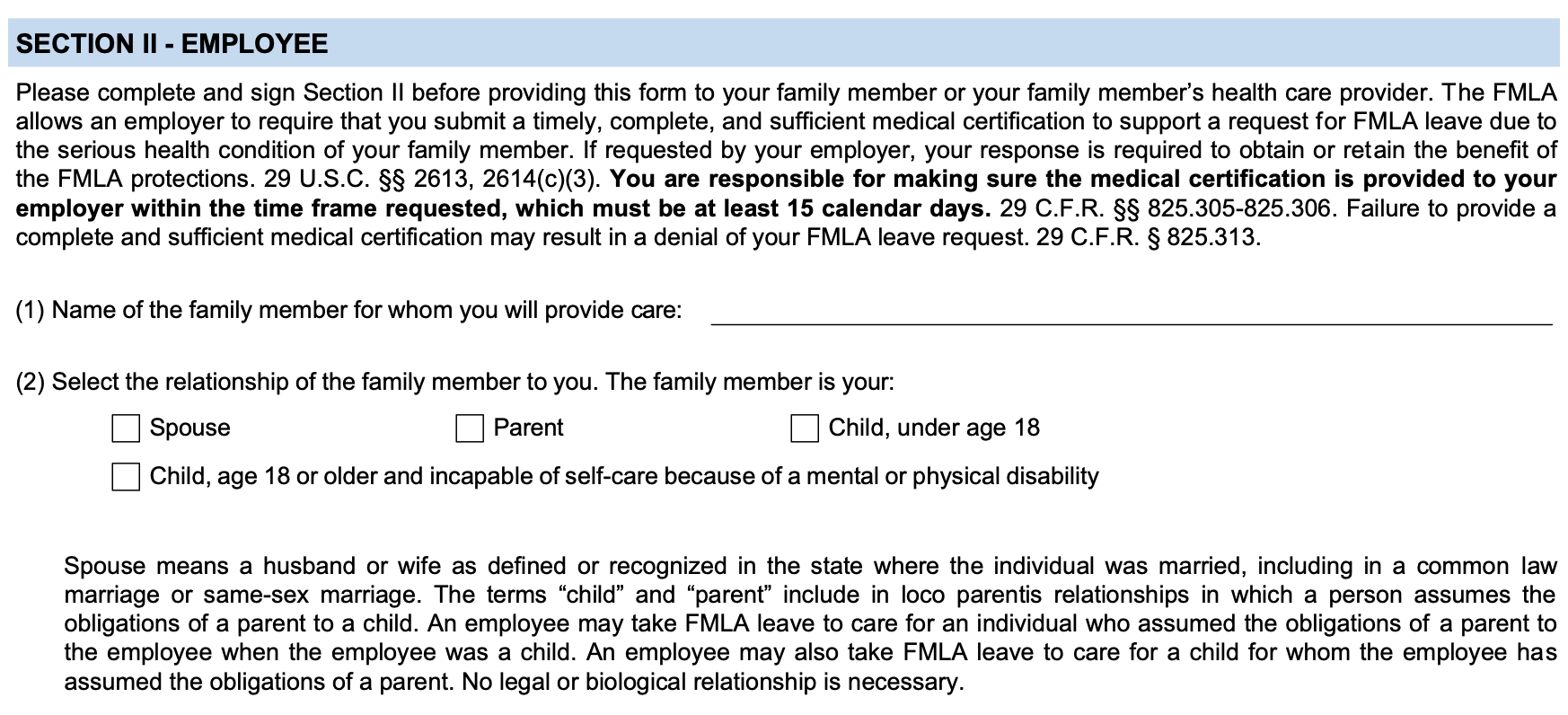
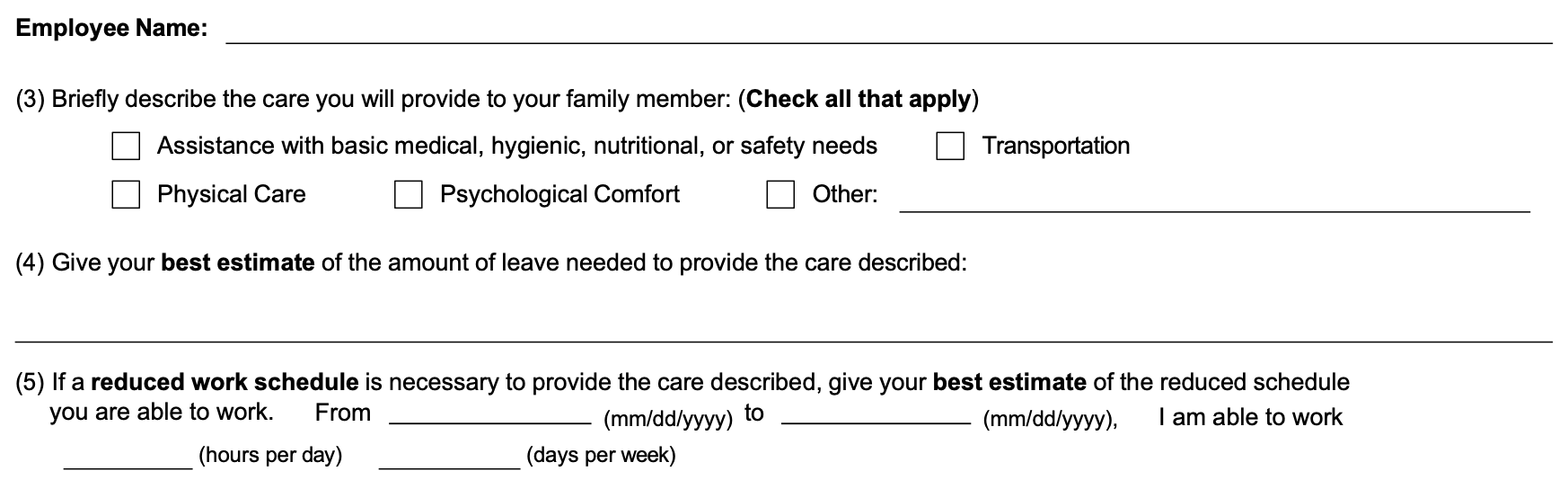
You need to recognize Section II so you know when it is missing, not so you can fill it in. The employee writes the name of the family member they will care for; they check the appropriate box to indicate their relationship (spouse, parent, child under 18, or a child 18 or older who cannot look after themselves because of a disability); select the appropriate box to indicate the kind of care they will provide (help with basic medical, hygiene, nutrition or safety needs; transport; physical care; psychological comfort; or other); estimates how much time off they need; and, if they need a shorter working week rather than time away, writes the hours per day and days per week they can work. Then they sign and date it.
Notice that last one. On the WH-380-E, you certify a reduced schedule. On this form the employee states it themselves; it is not yours to complete.
If Section II comes to you blank, do nothing with it. Do not fill it in, and do not have your assistant phone the daughter for the answers. It is the employee’s statement about a family relationship, and you have no way to verify one: you do not know who is a spouse, and the form allows a parent-child relationship with no legal or biological tie at all, which is not a clinical question. Complete your Section III, hand the form back, and tell your patient the employee has to complete and sign Section II before it goes to the employer.
Do read it, though, before you write anything. The reason is in item 4.
The rule: 29 C.F.R. §§ 825.122, 825.305.
Section III: your contact block
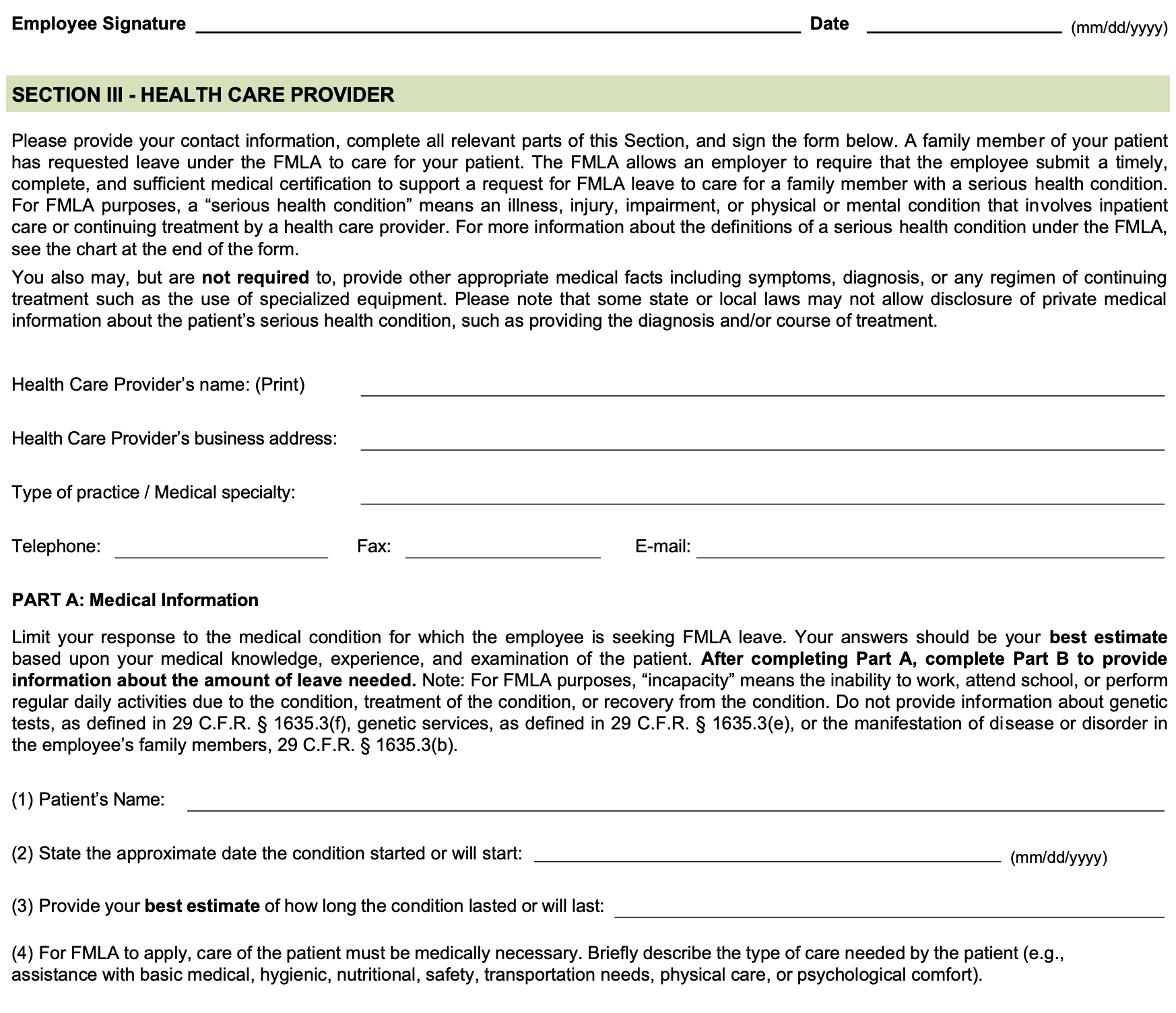
Write your name exactly as you’ll sign it on page 4, then the practice’s address, phone, fax and email, and your type of practice or specialty (family medicine, say, or orthopedic surgery). If HR needs to confirm you filled the form in, or to ask what one of your answers means, this is how they’ll reach you.
Item 1: the patient’s name
Write your patient’s name: the person who is ill, the one in front of you. Not the employee’s.
The trap is the header. Pages 2, 3 and 4 each open with a line marked “Employee Name”, and putting the patient’s name there instead of the employee’s name is the most common mistake clinicians make when they fill out the WH-380-F. Employee Name is the family member who works. Patient’s Name, here in item 1, is your patient. Getting the two the wrong way round makes the whole form look unread.
Item 2: when did the condition start?
Write your best estimate of when it began or will begin. A month and a year is fine, and so is “approximately 2019” for something long-standing.
Item 3: how long will it last?
This asks about the condition, not the time off. Write a range in weeks or months, for example “six to eight weeks” or “three to six months”. For a condition that will not end, “ongoing, chronic condition” is a complete answer, as long as item 10 says how often the bad days come and how long each one lasts. Nevertheless, for a patient with a chronic condition where the need for FMLA leave will continue, expect that you will need to periodically resubmit FMLA certification. HR can ask you to recertify, in most cases about every six months. In my experience, it is simplest to give a range of no more than six months, even for a condition that will not end, and fill out a new form when HR asks you to recertify.
Avoid “unknown”, “indeterminate” or “lifetime” in this box. HR reads your answer to plan how much time off to approve, and “unknown” or “indeterminate” gives them nothing to build a schedule or a staffing plan around. “Lifetime” may be true of the condition, but it still tells HR nothing they can plan with. Any of the three may get the form sent back with a request to clarify.
The rule: 29 C.F.R. § 825.308.
Item 4: what care does your patient need?
This box has no equivalent on the WH-380-E, and it is the reason this form exists. The first sentence printed in it is the legal test: for the leave to apply, care of the patient must be medically necessary. On the employee’s own form you certify that the employee cannot work. Here you certify that your patient needs someone.
Write the care, not the diagnosis. “Status post stroke with residual left-sided weakness” is a fine clinical sentence and it answers the wrong question: it says what is wrong with your patient, not why the daughter has to be somewhere other than work. The form hands you the vocabulary in its own example list, and those words are worth using because they match the boxes the employee checked in Section II: help with basic medical, hygiene, nutrition or safety needs; transport; physical care; psychological comfort. For the patient above: “Requires help with bathing, dressing and taking medication; cannot drive and needs transport to physical and occupational therapy three times a week; needs supervision for safety because of fall risk and impaired judgment.” Every phrase is something a person has to be physically present to do.
Psychological comfort counts. It is printed on the form as a kind of care. If your patient needs a familiar person there, someone with dementia who becomes agitated and unsafe alone, someone in the last stage of an illness, that is care, and you are allowed to say so. Clinicians leave it out because it feels too soft to write down. It is on the form. Write it.
Arranging care counts too. Time the employee needs to make arrangements for a change in your patient’s care, such as a move into a nursing home, is covered, and so is time spent standing in for whoever usually looks after your patient.
Now the reason to read Section II first: look at what the employee checked as the care they will provide, and make sure your item 4 does not contradict it. If the daughter checked transport and physical care and you write “independent in daily activities”, you have just denied her leave, not because either of you lied, but because nobody looked at the other half of the page. You are not obliged to agree with her; do not write what you do not believe, because it is your signature. But if the honest answer is “needs help with transport, not with physical care”, write exactly that. A precise partial answer holds up. A contradiction nobody noticed does not.
The rule: 29 C.F.R. § 825.124.
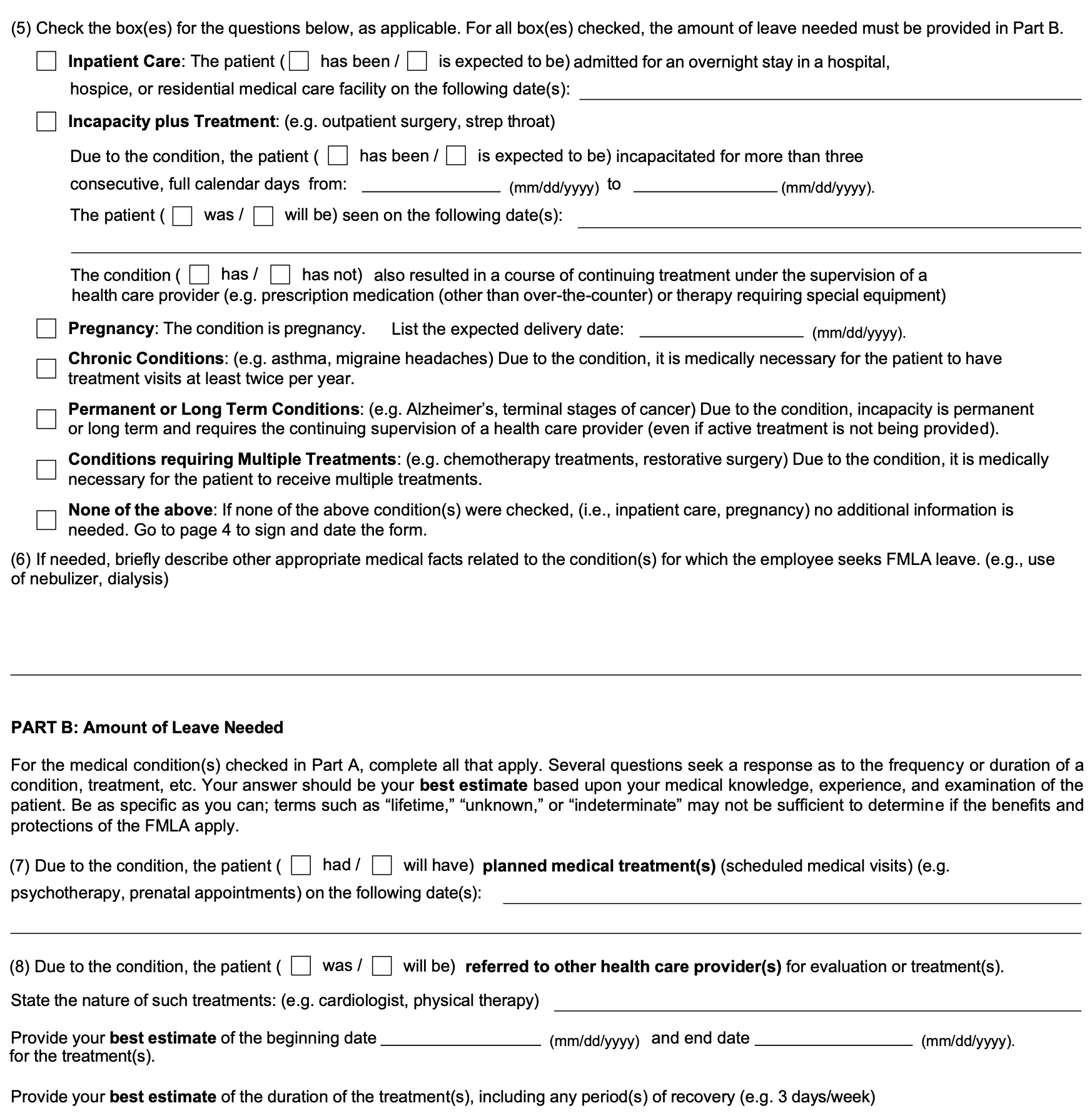
Item 5: which kind of condition is it?
What “incapacity” means here. On this form, incapacity means your patient cannot work, go to school, or carry on normal daily life because of the condition, its treatment, or recovery from either. Your patient does not need a job for this to apply. A nine-year-old with pneumonia who cannot go to school is incapacitated. So is a retired father after a hip replacement who cannot bathe, dress or get to his appointments without help. Each is a reason a family member may need time off to be there.
Item 5 is the WH-380-E’s item 3 under a different number. It’s still the same six kinds of conditions, and the patient has to meet the criteria of one of the six boxes. A patient admitted overnight fits “Inpatient Care.” A patient who couldn’t get through their normal day for four or more days in a row, and was seen for it, may fit “Incapacity plus Treatment.” Check every box that applies and then complete the lines beneath it. Those fields are the evidence to support the selected box or boxes. Empty lines under a checked box are one of the chief reasons these forms are not accepted. Whatever box or boxes you select here, their time impact has to be documented in Part B.
Don’t let the box names confuse you. They read like diagnoses, but basically they sort time, not disease. If you asked me as a physician whether diabetes is chronic or permanent, I would answer both. This form is somewhat counterintuitive for a physician, because it makes you pick one, and the choice depends on how the condition affects your patient’s normal day. One patient’s situation could fit in several boxes at once. Consider a father who had a stroke with partial left-sided weakness. He could have a week in the hospital, then a skilled nursing facility, then outpatient physical therapy three times a week, with someone at home for good because unfortunately the deficits didn’t improve enough to live safely without the extra help. That’s inpatient care, multiple treatments, and permanent or long-term, and all three boxes can be checked. Here they are in the order the form prints them:
| Box | Check it when the time lost looks like this | Then fill in |
|---|---|---|
| Inpatient care | One stretch that starts with an overnight stay in a hospital, hospice or residential care facility, past or scheduled. The recovery at home afterwards is part of the same stretch. | The admission date or dates. The whole stretch, recovery included, goes in item 9. |
| Incapacity plus treatment | One stretch of at least four days in a row when your patient could not manage their normal day, meaning three full days plus any part of a fourth, from an illness or procedure that then ends: an outpatient surgery, a bad infection. They also saw a clinician twice within 30 days, or once within 7 days and started ongoing treatment. Those are the patient’s days, not the employee’s days off work. Single bad days from a recurring problem do not fit here; see chronic conditions. | The first and last days of the stretch, the visit dates, and whether ongoing treatment started. The time goes in item 9. |
| Pregnancy | Any time the pregnancy keeps your patient from their normal day: prenatal visits, severe morning sickness, prescribed bed rest, delivery and recovery. There is no four-day minimum, and a bad day counts even if they were not seen that day. | The expected delivery date. Prenatal visits go in item 7, bad days in item 10, delivery and recovery in item 9. |
| Chronic conditions | Bad days that come and go over months or years, with your patient managing normally in between: an asthma attack, a seizure, a run of unstable blood sugars. The condition needs a clinician at least twice a year. Each lost day counts on its own, with no four-day minimum and no visit needed that day. | Nothing on these lines. How often the bad days come and how long each lasts goes in item 10. |
| Permanent or long-term conditions | Lost time that does not come and go and will not get better, because treatment cannot reverse the condition, though a clinician still has to supervise it even when no active treatment is under way: advanced dementia, the terminal stages of cancer, a stroke with lasting deficits. | Nothing on these lines. The time, usually one long stretch, goes in item 9, and any unpredictable extra days in item 10. |
| Conditions requiring multiple treatments | The treatments themselves are what cost the time: chemotherapy, radiation, dialysis, a series of physical therapy visits. Your patient may manage fine between sessions but need someone to get them there and back. It covers restorative surgery after an accident or injury, or any condition that would keep your patient from their normal day at least four days in a row if it went untreated. | Nothing on these lines. The treatment dates or schedule go in item 7, or item 8 if you referred them elsewhere. |
What counts as ongoing treatment? For the incapacity plus treatment box, it means care you prescribed and are following, such as a prescription medication, a course of physical therapy or a piece of medical equipment. Rest and over-the-counter remedies can be appropriate medical advice, but on their own they don’t meet the requirement of this section of the form.
Chronic, or permanent and long-term? These two are easily confused. The decision is actually the pattern of the days of incapacity, not whether the disease will ever go away. A mother with heart failure who manages okay most days but has occasional flare-ups causing incapacity that requires the family member’s help at those times would fit “chronic” better than “permanent or long-term”, even though her heart failure will not resolve. Permanent or long-term is for a condition that incapacitates her all the time. For example, if, despite optimal medical therapy and interventions, the heart failure symptoms cause daily incapacity requiring daily help from her family member, then “permanent or long-term” would be appropriate.
If none of the six boxes fits, check “None of the above”. Be clear about what it means: you are telling the employer that your patient’s condition does not qualify, and the caregiver’s leave will be denied. If that is the honest answer, it is the right one. But do not check it by default: if a box fits, check that box and fill in its lines. And if the answer is no, tell your patient before the form leaves the room.
The rule: 29 C.F.R. §§ 825.113 (incapacity is defined in 825.113(b)), 825.114, 825.115, 825.120(a)(4).
Item 6: anything else worth saying? (optional)
This box is optional. You can add information about your patient’s condition that helps explain the care they need, such as their symptoms, the treatment plan, or equipment like a nebulizer. The form itself says you are not required to add these other medical facts, and it also points out that some state laws limit what diagnosis you are allowed to disclose. For example, my understanding is that California’s own leave law does not require the diagnosis at all. What I do is follow the privacy rules and leave the diagnosis off the form, and instead I describe the symptoms and the care that is scheduled. In my experience that gives HR enough to understand why the leave is needed, and it makes it more likely the leave will be approved. It’s the same approach I use for item 4 on the WH-380-E. I write the symptoms, what they keep my patient from doing, and the treatment described as time rather than as a medication name. I also try not to name an organ system if that would give away the diagnosis. My understanding is that mental health conditions, addiction treatment and HIV status are treated as especially sensitive in at least some states, in addition to the federal rules that protect addiction treatment records and psychotherapy notes. If your patient’s condition falls into one of these areas, it is especially important to leave the diagnosis off the FMLA paperwork.
One instruction on this form reads strangely, and it’s worth understanding so you don’t over-correct. Part A tells you not to describe “the manifestation of disease or disorder in the employee’s family members.” Your patient is the employee’s family member, so if you read that sentence literally it would rule out the whole form. That wording was carried over from the employee’s own form, the WH-380-E, and certifying your patient’s condition is the whole reason this form exists. So go ahead and certify it. What should still stay off the form is information about anyone else in the family. There is a federal law called the Genetic Information Nondiscrimination Act (GINA), and to comply with it you should not put genetic information or family history on this form. That means no “strong family history of stroke,” no “her son also has high blood pressure,” and no genetic test results or genetic counseling. Your patient’s condition belongs on the form, but the rest of the family’s health does not.
The rule: 29 C.F.R. §§ 825.306, 1635.3; Cal. Gov. Code § 12945.2 and 2 C.C.R. § 11091; 42 C.F.R. Part 2; 45 C.F.R. § 164.508(a)(2).
Item 7: planned appointments
If you know the dates of your patient’s scheduled appointments, write them here. If you don’t, write the pattern instead, for example “physical and occupational therapy three times a week.” The time the employee takes off to bring your patient to these appointments is protected, so listing them helps the employee. Writing “scheduled medical visits” with the dates is a complete answer, and it avoids giving out more health information than the form needs.
Item 8: referrals to other clinicians
If you have referred your patient to someone else, write what the referral is for (for example a medical specialist or physical therapy), the start and end dates of that treatment, and how much time each visit takes. The box says “including any period of recovery.” A lot of clinicians write the treatment dates and stop there, but the recovery time is part of the answer too. Be careful with the name of the specialty, because it can give away the diagnosis. Writing “oncology,” “psychiatry” or “infectious disease” basically tells the employer what is wrong. When naming the referral would reveal the diagnosis, I would suggest describing it as a treatment schedule instead, such as “medical specialist evaluation and treatment, monthly” or “physical therapy, three days a week.” That fully answers what the form asks. If HR does ask for more information, they have to give the employee seven days to respond. They also cannot ask you for anything beyond what the form itself asks, and they cannot contact you about it without permission.
The rule: 29 C.F.R. §§ 825.305(c), 825.306(a)(3), 825.307(a).
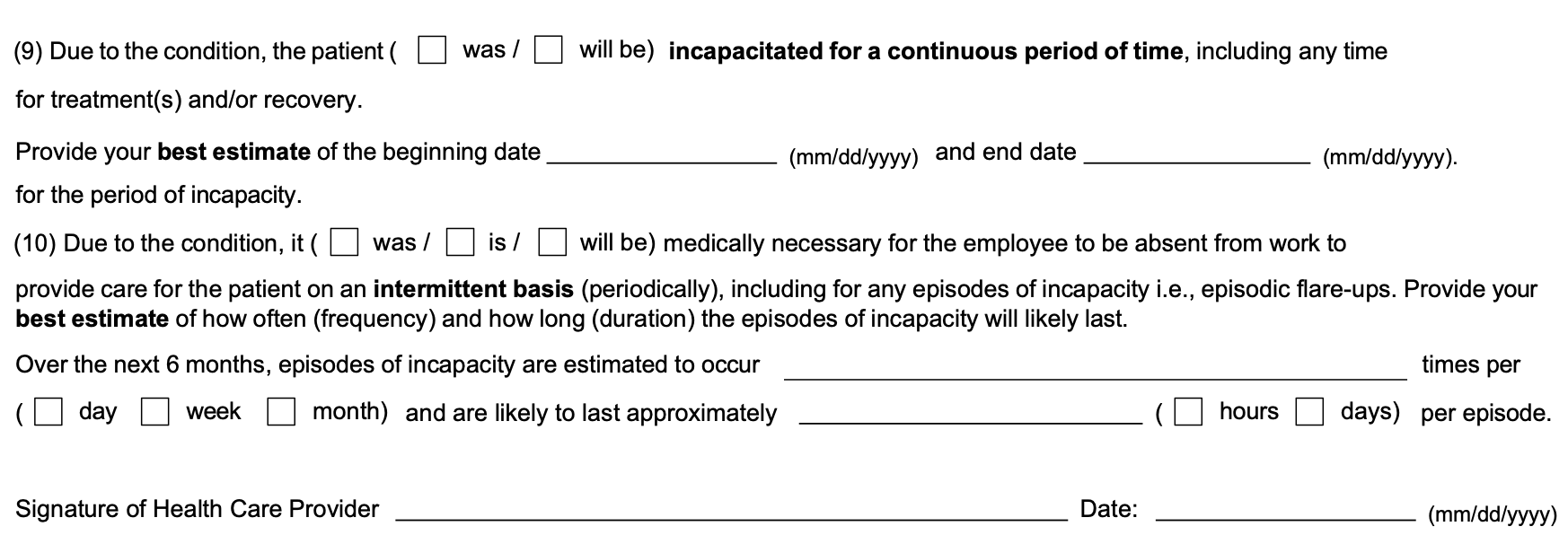
Item 9: one continuous block of time
If your patient will be unable to manage their normal day for one unbroken stretch, including treatment and recovery, write a start date and an end date. A best estimate is what is asked. If you truly cannot say, give a review date and explain why in item 6; an empty end date reads as “unknown” and often gets the form sent back. For example, your patient is in hospital after a hip fracture, and whether she goes home or to a rehabilitation facility is decided at a care meeting next week. Write an end date one week after that meeting, and in item 6 write “Length of care needed depends on discharge planning on [date]; I will re-evaluate then.”
Item 10: time off in episodes
Read this one carefully, because it is worded differently from the WH-380-E in a way that matters. It asks whether the employee needs to be away from work, now and then, to look after your patient during flare-ups. On the other form you certified that the patient could not work. Here you are certifying that someone else needs to be away from their job because your patient needs them there.
Then the numbers, in the form’s own frame: over the next six months, write how often the flare-ups happen (times per day, week or month) and how long each one lasts (hours or days). It needs both numbers. “About two to three days a month for falls, illness and unscheduled visits” is a complete answer. “As needed” is not. A frequency with no duration, or a duration with no frequency, is the other answer that most often gets the form sent back to the employee to be fixed. Two patterns can run together: the standing therapy schedule in item 7 and the unpredictable days here.
This is where having your patient in the room, and ideally the employee too, matters most. For a chronic condition that flares, ask how often the flares have been coming and how long each one needs the employee there, and settle the numbers together. If you estimate from the chart alone, your estimate may fall short of the care your patient actually needs, and the employee may contact your office to ask for the form to be amended.
And the “lifetime” trap, once more. Your patient’s deficits may well be permanent, but item 10 asks about the next six months. Answer the question in front of you.
Sign on page 4, yourself
Sign and date at the bottom of page 4, with the same name you printed in your contact block. Your assistant cannot sign this. And notice what is not there: on the WH-380-E, Part C asked you to name a core part of the job your patient could not do. There is no Part C on this form and no job question at all. You have never met the employee and nobody asked, so do not volunteer an opinion about whether the daughter can do her job.
The employee signs their own line at the end of Section II. A form where the provider has signed the employee’s line is a form that will not be accepted.
Who carries it out of the room
The bottom of page 4 says, in capitals, return it to the patient, never to the Department of Labor. On the WH-380-E that is the end of it: your patient carries their own medical information to their own employer. On this form the completed certification has to reach the daughter’s employer, and the daughter is not the patient. Handing it to her is a disclosure of your patient’s medical information to someone else, and “she is his daughter” is not, by itself, your permission to do that.
My understanding is that the details turn on your state and your practice’s own policy, so raise this with your privacy officer. My practical approach: at the visit where you complete the form, get a signed authorization from the patient, or from whoever properly speaks for the patient, naming the employee and the employer as the people who may receive it. If the patient is a competent adult, it is their information and their call, and it takes ninety seconds while they are in the room. If the patient is a minor child, the parent generally speaks for them and you give it to the parent. If the patient is an adult who cannot decide for themselves, you need to know whether the employee actually holds that authority (guardianship, power of attorney, a health care proxy); the relationship box in Section II is the employee’s statement to their employer, not proof of who may receive records from you. Use your practice’s own authorization form, then note in the chart what you released and to whom.
Do not fax it to the employer’s HR yourself. If HR calls afterwards, they may only confirm you filled the form in or ask what an answer means, and never through the employee’s direct supervisor. If someone is fishing for detail you deliberately left out, you can say no.
The rule: 29 C.F.R. § 825.307.
Why it is not accepted: the six usual suspects
- Section II is blank, or the provider filled it in or signed the employee’s line.
- Item 4 describes the diagnosis instead of the care the patient needs, or contradicts what the employee checked in Section II.
- Item 3 says “unknown”, “lifetime” or “indeterminate”.
- Item 10 has how often but not how long, or the reverse, or says “as needed”.
- A box is checked in item 5 but the lines under it (visit dates, admission date) are empty.
- The patient’s name is in the “Employee Name” header, or the answers were written from memory of the WH-380-E and landed on the wrong item.
When the fix is small, you often do not need a new form. If only a number changes, say flare-ups go from once a month to twice a month, in my experience HR will usually accept the change written on the original form: cross out the old answer with a single line, write the new one beside it, initial and date it, and send it back.
PatientPapers makes completing the WH‑380‑F easier
Every “gotcha” on that list is something software can catch before you sign. I created PatientPapers to make it easier and faster for you to complete this paperwork, because as a physician myself, I understand the burden of this paperwork and wanted to do something to decrease it. It is my own product, built through the same company as this site, so weigh this accordingly. It keeps the employee’s sections and yours apart, asks the patient-side questions in the patient’s terms, and fills in the real form for you. You review it before you sign. The pricing and the full description are on the PatientPapers site.
Open PatientPapers