Can you charge for FMLA paperwork?
You have several FMLA forms patients dropped off sitting in your inbox on your desk waiting for you to complete. Each one is ten to twenty minutes of chart review and clinical judgment, and currently each one is being done for free. Can you get paid for this work?
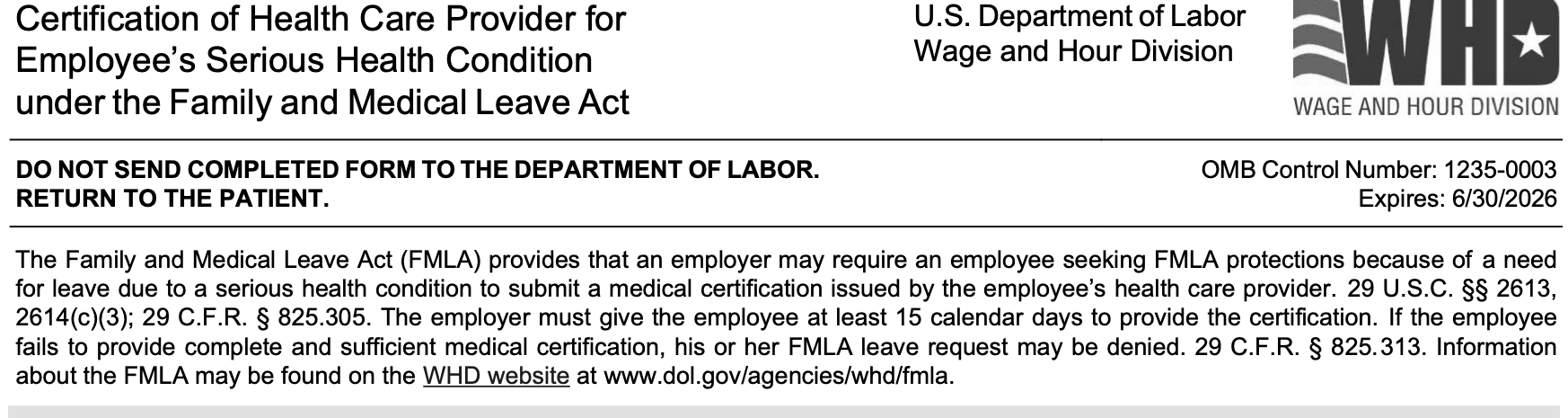
- Regulation
- 29 C.F.R. §§ 825.305, 825.307, 825.308
- Who pays for the initial certification
- the employee
- Who pays for a second or third opinion
- the employer
- Commonly reported fee
- about $25 to $75 per form, often waived during a billed visit
Key points
- In most cases, yes. The FMLA regulations put the cost of the initial certification and any recertification on the employee. No federal rule requires you to complete it free.
- Insurance almost never covers form completion; it is administrative, not a covered service. That is why a direct patient fee is the norm where practices charge.
- Check before you post a fee: payer contracts, your state (some allow a fee and some forbid it, especially for state paid-leave forms), workers’ comp and disability carriers, and your employer’s policy if you are employed.
- Have a written policy, make sure the fees are communicated clearly to the patient when they drop off the form, commit to a turnaround inside the employee’s 15-day deadline, and waive it during billed visits.
What the regulations say about who pays
| Document | Who pays | Cite |
|---|---|---|
| Initial certification | The employee. The DOL’s own employee guidance says the employee is responsible for the costs of completing the form. | § 825.305 |
| Recertification | The employee, unless the employer volunteers otherwise. | § 825.308 |
| Second or third opinion | The employer. If an employer doubts your certification and sends the employee elsewhere, that cost is the employer’s by regulation. | § 825.307 |
Nothing in the FMLA or its regulations obliges a health care provider to complete FMLA paperwork for free. The fee is between you, your patient and your contracts, not the statute.
Why insurance does not solve this
Form completion is an administrative service, not a covered medical benefit, so health plans generally do not pay for it on its own. That is why practices that charge bill the patient directly.
Many practices simply fold the form into an office visit and charge nothing extra. That works only when the visit is a real one: you are seeing the patient for a medical problem, addressing it, and the form rides along. A visit whose only purpose is filling out a form is not a billable visit, so “fold it in” is not a way to get insurance to pay for the paperwork. Whether the minutes spent on the form can count toward the level of a visit that stands on its own is a coding question for your billing team, not something this page will answer. Considering the growing costs for the overhead of medical practices, the significant time required to complete the forms by the traditional route, plus the impact of the administrative burden on clinicians who are already struggling with burnout, providing this service for free may not be a viable financial option or advisable for practice or physician well-being.
What practices typically charge
There is no standard rate. Published practice policies and industry commentary commonly land around $25 to $75 per form, with simple work notes cheaper and multi-page disability packets higher. One published example: $35 for standalone completion, nothing during a visit. Two anchors when setting yours: the time (a WH-380-E done by hand is 10 to 20 minutes of clinician time plus staff handling) and the patient’s alternative (if their FMLA form is not accepted on the first submission, the time lost on the first submission counts against the 15-day deadline, meaning that they might not get their leave approved unless the second submission is executed flawlessly).
The exceptions to check first
- Payer contracts. Some managed-care, Medicaid and employed-physician agreements restrict billing patients for administrative services. Read yours, or ask your billing manager, before charging plan members.
- Your state. My understanding, from reading the statutes, regulations and agency pages myself, is this. No state forbids a fee for the federal FMLA form. Nevada caps it at $30, adjusted yearly. Four states forbid a fee for their own state leave form: Connecticut, Delaware (which pays you a small amount for filing it promptly instead), New Jersey and Washington. California and DC say a fee for the state form is allowed. If your patient is on Medicaid, assume you cannot charge them: Maryland, Texas, Tennessee, New York, Delaware and California say so in plain words, and most other states’ manuals treat forms as part of the visit you were already paid for. For every state not named here I found no rule either way, and “no rule found” is not the same as “allowed”. This is one physician’s reading, not legal advice; your state medical society can tell you if something has changed.
- Workers’ compensation and disability carriers run under different rules; those forms often carry their own payment mechanism.
- Employed physicians. Your employer may already have a policy, and may keep the fee.
A fee policy that does not create friction
- Write it down. One page: which forms, the fee, the turnaround, and that payment is due before standalone completion.
- Say it early. At check-in, on the portal, and at the front desk when the form is dropped off. Posted fees get accepted; surprise fees get complaints.
- Commit to a turnaround. The employee has at least 15 calendar days. Promise three to five business days and hit it, and the fee feels like a service rather than a toll.
- Waive strategically. During billed visits, for hardship, for forms that take under two minutes. Consistency plus documented exceptions beats ad-hoc decisions.
- Never hold care hostage. The fee applies to the form, never to the patient’s clinical needs.
The other half: make the form cheap to produce
A fee only turns paperwork into revenue if completing the form costs you less than you charge. Busy work like re-typing your name, address and other details, as well as the chart review and cognitive effort to map the patient’s situation to the FMLA regulatory phrasings on every form, is where the twenty minutes goes. Storing your provider details so they do not have to be re-entered every time, and having software walk you through the form to ease the cognitive burden and uncertainty, saves you time and helps you complete the FMLA form more confidently, so that the fee you can get for completing the form starts to look like a reasonable hourly rate.
That is what I built PatientPapers to do, and it is my own product, so weigh this accordingly. It keeps your name, address and specialty on file, asks the FMLA questions in plain English, and fills the real Department of Labor form for you to review and sign. The form takes a few minutes instead of twenty, which is the difference between a fee that covers your time and one that does not.
The short answers
Is it legal to charge? Generally yes. The regulations place certification costs on the employee and no federal rule requires free completion. Confirm your payer contracts and your state’s rule first; some states forbid a fee for their own leave forms.
Does insurance cover it? Usually not.
How much? Commonly reported fees run roughly $25 to $75 per form. Anchor on your time and the form’s complexity.
Disclosure
PatientPapers is my own product, built through the same company as this site. It is the software half of the fee argument: stored provider details, the regulatory phrasings built in, and the real PDF filled, so completing the form costs a few minutes rather than twenty. You review the completed form before you sign it. The pricing and the full description are on the PatientPapers site. The full article, with the sources for each figure, is there too: Can you charge for FMLA paperwork?
Open PatientPapers