WH‑380‑E, field by field
Has this happened to you? A patient surprises you with FMLA paperwork, the WH-380-E, at the end of a fifteen-minute visit, expecting you to fill it out for them now, and you have two more patients waiting to be seen. And on top of that, if you fill it out incorrectly, you will have to redo it, and your patient’s leave may not be approved.
- Form
- WH-380-E, Certification of Health Care Provider for Employee’s Serious Health Condition
- Issued by
- U.S. Department of Labor, Wage and Hour Division
- Revision
- June 2020
- OMB control number
- 1235-0003, expiry printed as 6/30/2026
- Return to
- the patient, never the Department of Labor
Key points
- Page 1 belongs to the employer. Your part starts at Section II on page 2. If the employer left page 1 blank, leave it blank.
- If the form arrives with no word about why your patient needs leave, have your front desk schedule a visit within a couple of days rather than guessing from an old note. Your patient’s 15 days to return the form are already running.
- Item 2, how long it will last: write a range in weeks or months, or “ongoing, chronic condition” when item 9 carries the numbers. Never “unknown”, “lifetime” or “indeterminate”.
- Item 9, time off in episodes: write how often and how long each time. One number without the other often gets the form sent back.
- Part C: name one core part of the job your patient cannot do right now. Time off for appointments counts.
- Item 4 (optional) is where you describe your patient’s medical situation. Leave the diagnosis out; the form itself warns that some states may not allow you to disclose it. Instead, describe the symptoms and what they stop your patient doing. Do not write family history or anything genetic, to stay within a federal genetic-privacy law (GINA). If HR calls, they may only confirm you filled it in or ask what an answer means.
Before you start: what this form is and who fills in what
The WH-380-E is the Department of Labor’s form for an employee who needs time off for their own health condition under the Family and Medical Leave Act. You are describing your patient’s serious medical situation and the time they need away from work because of it, so that their job will be protected.
Page 1 is the employer’s: the employee’s name, job title, hours and a description of the job. Your part starts at Section II on page 2 and runs to your signature on page 4. If the employer left page 1 blank, leave it blank; it is not your responsibility to fill out page 1.
Strictly speaking, your patient has 15 days from the day Human Resources (HR) asked to get this form back to them. If HR decides an answer is missing or too vague, they send it back and give your patient seven more days to get it fixed. If the corrected form is still not acceptable, the leave can be denied. So a form that comes back is at best a hassle for your patient and for you, and at worst it can cost them the leave.
The rule: 29 C.F.R. §§ 825.305, 825.306, 825.313.
When the form arrives at the wrong moment
Back to the scene at the top of this page: the form comes out as your patient is getting up to leave. Here is what I do. I take a minute to find out what the leave is for. Even when it is the problem we just discussed, I usually still need a few questions about their job and how the condition affects it, and some kinds of leave need more than that. If it will take more than about five minutes and there is no time, I say something like: “I want to help you with this. To fill it out so your HR will accept it, I need to ask you more questions than we have time for today, and I have other patients waiting. Let’s book a visit in the next couple of days just for this form.”
Often the FMLA form is dropped off at the front desk by a patient with no information provided about why they want to apply for FMLA leave. I know my patient as of their last visit. If something new has happened since, or the problem never came up at that visit, I have no sound basis for what I am being asked to certify. Patients usually do not know what the form asks for, and front-desk staff often do not either.
In my experience, to fill out the form correctly you need to talk with the patient, and in my opinion in person is best. You need to know what is going on now, how it affects their work, and the answers to the questions the form will ask you. So when an FMLA form arrives without that, have your staff call the patient and schedule an appointment, rather than trying to piece the story together from an old note and your best guesses.
Better still, educate your front-desk staff before the next form comes in. When a patient drops off FMLA paperwork and a visit is needed, staff can explain why and schedule it within a couple of days. The clock on your patient’s 15 days to return the form is already running.
Two ideas the form assumes you already know
Nearly every box you fill in rests on two ideas that medical training never covers: your patient’s essential job functions, meaning the core duties of their job, and incapacity, meaning the condition, its treatment or the recovery has stopped them from working. How long that lasts, whether a day, six weeks or a few days every month, is a separate question, and it is the one Part B asks. Once you understand these two, you see that the form is essentially asking: is your patient’s medical situation stopping them from doing one or more of their essential job functions, and for how long?
The core duties of the job (essential job functions)
These are the things the job exists to do. For example, a nurse lifting and turning patients, or a truck driver driving their rig, or an accountant working on spreadsheets. By contrast, non-essential job functions are tasks that could be handed to someone else: restocking the supply room for the nurse, washing the truck for the driver, or covering the front desk phone at lunch for the accountant. The employer describes the core duties on page 1; if page 1 is blank, go by what your patient tells you the job involves.
The question is not “can my patient work?” It is “can my patient do this job?”, and the answer is no if they cannot do even one of its core duties. A warehouse worker four weeks out from knee surgery could sit at a desk, but if lifting is a core duty of their job, they cannot do their job, and that is the answer the form needs. Being away from work for treatment also counts: during an infusion or a physical therapy session, your patient is not doing their job.
You are naming one core duty your patient cannot do, and why. That answer goes in Part C.
When the condition stops them working (incapacity)
For this form, “incapacity” means your patient cannot work because of the condition, because of its treatment, or while recovering from either. Incapacity is the state; how long it lasts is a separate matter, and the form calls that stretch a period of incapacity. The day of bowel prep for a colonoscopy, the week after a cholecystectomy, the afternoon a migraine makes working impossible: each is a period of incapacity.
How long it lasts depends on the medical situation, and it comes in two shapes that the form asks about separately. One continuous stretch, such as recovery from surgery, goes in item 8. Episodes that come and go, such as flare-ups, go in item 9. For a chronic condition or a pregnancy, a single bad day counts even if your patient never came in to be seen that day, and even if it is shorter than the four days in a row that some other boxes require.
The “incapacity plus treatment” box needs at least four days in a row of it (three full days plus any part of a fourth), not a few days of feeling unwell at work. Those are calendar days, not shifts: a weekend counts if your patient was too ill to get through a normal day, even though they were not due at work.
The rule: 29 C.F.R. §§ 825.113(b), 825.115(f), 825.123(a); the core-duties definition comes from 29 C.F.R. § 1630.2(n).
Section II: your contact block
Print your name (the same name that signs page 4), your practice address, phone, fax and email, and your type of practice or specialty (for example, family medicine or orthopedic surgery). HR uses this block to reach you if they need to confirm you completed the form or ask what an answer means.
Item 1: when did the condition start?
Write your best estimate of when it began or will begin. A month and a year is fine, and so is “approximately 2019” for something long-standing.
Item 2: how long will it last?
Write a range in weeks or months, for example “six to eight weeks” or “three to six months”. For a condition that will not end, “ongoing, chronic condition” is a complete answer, as long as item 9 says how often the flare-ups come and how long each one lasts. Nevertheless, for a patient with a chronic condition where the need for FMLA leave will continue, expect that you will need to periodically resubmit FMLA certification. HR can ask you to recertify, in most cases about every six months. In my experience, it is simplest to give a range of no more than six months, even for a condition that will not end, and fill out a new form when HR asks you to recertify.
Avoid describing the leave time required as “unknown”, “indeterminate” or “lifetime”. HR needs to know how much time off to approve and descriptors such as “unknown” or “indeterminate” don’t give them enough information for them to build a schedule or create a staffing plan. In the same vein, “lifetime” describes the disease, not the time off. If you describe the time off required with “unknown”, “indeterminate” or “lifetime” it may cause HR to not accept the form you submitted as is and request clarification.
The rule: 29 C.F.R. § 825.308.
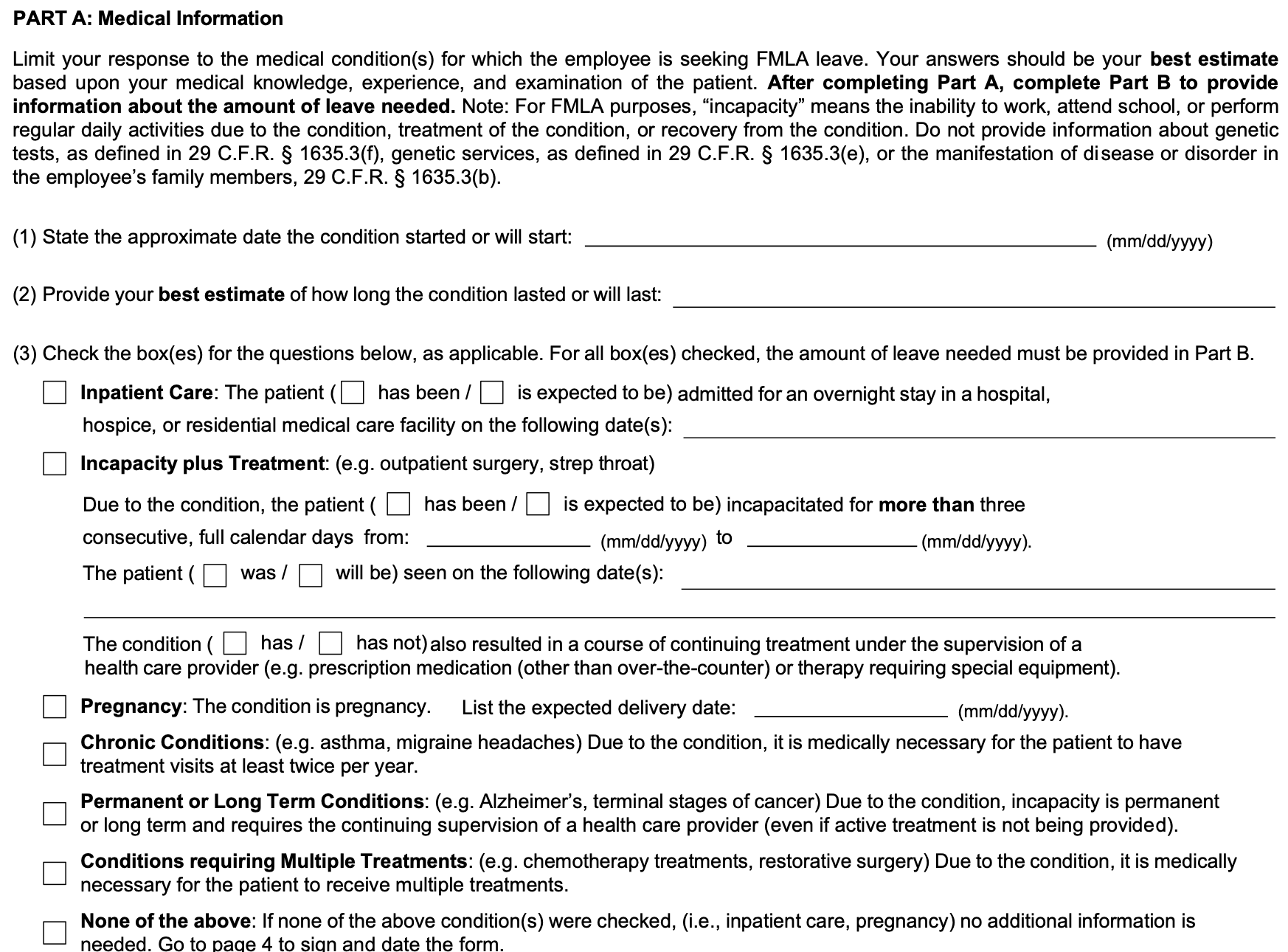
Item 3: which kind of condition is it?
FMLA requires that the leave is for a serious health condition, which it defines as fitting one of the items on a checklist that is provided, rather than a medical judgement on your part about how ill your patient is. Minor illnesses such as a cold or upset stomach usually do not count. A medical condition qualifies only if it meets the criteria of one of the six accepted categories. For example, a patient who could not work for at least four days in a row and came in to be seen could fit “Incapacity plus Treatment”. A patient who was admitted overnight would fit “Inpatient Care”. By selecting a particular box, you are asserting that the patient qualifies based on the criteria of that category. If none of the six fits, the honest answer is the last box, none of the above.
Put a check mark by every box that fits, then fill in the field under each box you ticked, which is the support for the box you chose. A ticked box with no supporting information written under it is the second most common reason a form is sent back.
The box names sound like diagnoses, and that can be confusing to clinicians. To a physician, diabetes is both chronic and permanent. On this form it is one or the other, depending on how it costs your patient time. So read the six boxes as six patterns of lost time, not six kinds of disease. One patient can fit several: someone with Crohn’s disease admitted for a flare, kept on infusions every eight weeks, and off work a day or two whenever symptoms return fits inpatient care, multiple treatments and chronic conditions at once. In that case, you would tick all three. The six, in the form’s order:
| Box | Tick it when the time lost looks like this | Then fill in |
|---|---|---|
| Inpatient care | One stretch that starts with an overnight stay in a hospital, hospice or residential care facility, past or scheduled. The recovery at home afterwards is part of the same stretch. | The admission date or dates. The whole stretch, recovery included, goes in item 8. |
| Incapacity plus treatment | One stretch of at least four days in a row unable to work, meaning three full days plus any part of a fourth, from an illness or procedure that then ends: a flu that kept them home a week, an outpatient surgery. They also saw a clinician twice within 30 days, or once within 7 days and started ongoing treatment. Single days lost to a recurring problem do not fit here; see chronic conditions. | The first and last days they could not work, the visit dates, and whether ongoing treatment started. The time off goes in item 8. |
| Pregnancy | Any time the pregnancy keeps your patient from work: prenatal visits, severe morning sickness, prescribed bed rest, delivery and recovery. There is no four-day minimum, and a bad day counts even if they were not seen that day. | The expected delivery date. Prenatal visits go in item 5, bad days in item 9, delivery and recovery in item 8. |
| Chronic conditions | Bad days that come and go over months or years, with your patient working normally in between: an asthma attack, a migraine, a run of unstable blood sugars. The condition needs a clinician at least twice a year. Each lost day counts on its own, with no four-day minimum and no visit needed that day. | Nothing on these lines. How often the bad days come and how long each lasts goes in item 9. |
| Permanent or long-term conditions | Lost time that does not come and go and will not get better, because treatment cannot reverse the condition, though a clinician still has to supervise it even when no active treatment is under way: advanced dementia, the terminal stages of cancer. | Nothing on these lines. The time off, usually one long stretch or reduced hours, goes in item 8 or item 7. |
| Conditions requiring multiple treatments | The treatment itself is what costs the time: chemotherapy, radiation, dialysis, a series of physical therapy visits. Your patient may be well enough to work between sessions. It covers restorative surgery after an accident or injury, or any condition that would keep your patient off work at least four days in a row if it went untreated. | Nothing on these lines. The treatment dates or schedule go in item 5, or item 6 if you referred them elsewhere. |
What counts as ongoing treatment? The incapacity plus treatment box asks whether your patient started ongoing treatment. On this form that means something you prescribed and are following up: a medication, physical therapy, or medical equipment. Rest or over-the-counter medicine may be the right care, but on its own it does not count as ongoing treatment.
Chronic, or permanent and long-term? This is the pair doctors mix up, because to a physician diabetes, multiple sclerosis and heart failure are all both. The form separates them by how the time is lost. If your patient works most days but misses work some days due to flare-ups, check the box for chronic conditions, even though the disease will never resolve. Check the box for permanent or long-term only when the condition keeps them from functioning all the time and treatment will not change that. Multiple sclerosis with an occasional relapse is chronic; Alzheimer’s or cancer in its terminal stages, the form’s own examples, is permanent or long-term. If your patient will need a permanently shorter workday, say six hours instead of eight, put that in item 7, the reduced schedule, whichever box you check.
When your patient will not be going back. If the condition has progressed to the point where your patient realistically will not return to this job, as with advancing dementia, FMLA can protect the job for up to 12 weeks, but my understanding is that if your patient still cannot do its core duties when the leave ends, FMLA gives them no right to keep it. The 12 weeks of FMLA leave may still be a useful benefit to the patient in this situation because the employer must keep your patient’s health insurance going on the same terms during the leave, and that time lets your patient and their family apply for disability benefits or arrange retirement before the job ends.
The rule: 29 C.F.R. §§ 825.113, 825.114, 825.115, 825.120(a)(4), 825.205, 825.209, 825.216(c).
None of the above
If none of the six boxes fits, tick this one. Be clear about what it means: you are telling the employer that your patient’s condition does not qualify for FMLA leave, and the leave will be denied. If that is the honest answer, it is the right one. But do not tick it by default: if a box fits, tick that box and fill in its lines. And if the answer is no, tell your patient before they hand the form in, so it is not their employer who breaks the news.
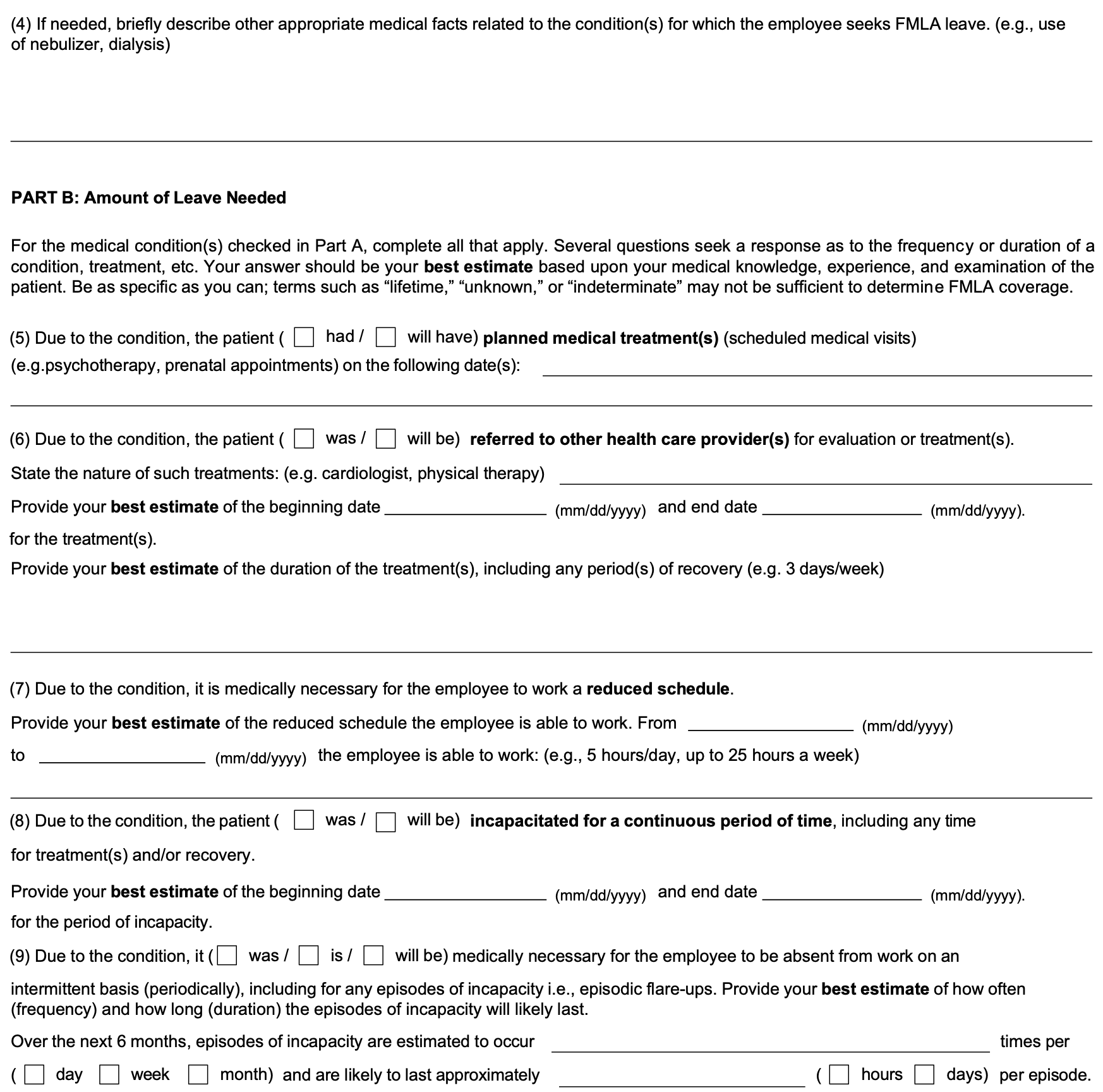
Item 4: anything else worth saying? (optional)
You may add facts about the condition that help explain the time off: symptoms, the treatment plan, equipment such as a nebulizer. The form says plainly that you are not required to add these other medical facts. This is the only box on the form where a diagnosis could go, and it is optional; the form’s next sentence warns that some state and local laws may not allow you to disclose the diagnosis at all. In California, for example, my understanding is that the state’s own leave law does not require the diagnosis for a certification to be complete, so an employer there cannot insist on it.
My approach is to follow the privacy rules, leave the diagnosis out, and describe the symptoms and the scheduled care instead. That gives HR what they need to see why the leave is needed, and makes it more likely to be approved. The employer is not deciding what disease your patient has. They are deciding whether the time off is protected, and for that they need the symptoms and how those map to the part of the job they stop. Write it in three parts, in one or two sentences: the symptoms that actually cost work (“recurring episodes of severe abdominal pain and urgent bowel frequency”), what those do to your patient at work (“during an episode they cannot stay on the factory line and need immediate restroom access”), and the treatment as time rather than as a drug (“a scheduled infusion every eight weeks, about four hours including travel”). You do not need to say what kind of condition it is. “A chronic condition” is enough; the symptoms carry everything the employer needs. That paragraph justifies every box in Part B better than the name of the disease does, and it discloses nothing the employer has no business knowing. The ongoing-treatment line in item 3 is a tick box, so you never have to name a medication either; some drugs are the diagnosis.
Some kinds of information are treated as especially sensitive, and the rules around them are tighter than the general ones. My understanding is that mental health conditions, addiction treatment and HIV status fall into that group in at least some states, on top of the federal rules that already protect addiction treatment records and psychotherapy notes, and that a general release your patient signed may not cover them. If your patient’s condition touches one of these sensitive privacy areas, it is particularly important to avoid disclosing their diagnosis on the FMLA paperwork.
Two other things to be very careful to avoid reporting on the FMLA form would be any genetic information about your patient or any condition in the patient’s relatives. There is a federal law called the Genetic Information Nondiscrimination Act (GINA), and to be compliant with that law you should not put genetic information or even family history information on this form.
The rule: 29 C.F.R. §§ 825.306, 1635.3; Cal. Gov. Code § 12945.2 and 2 C.C.R. § 11091; 42 C.F.R. Part 2; 45 C.F.R. § 164.508(a)(2).
Item 5: planned appointments
Write the dates of scheduled visits if you know them, otherwise the pattern, such as “monthly”. Time off for an appointment is protected time off, so listing them protects your patient. “Scheduled medical visits” plus the dates answers the question completely, avoiding disclosing more health information than required.
Item 6: referrals to other clinicians
If you have referred your patient elsewhere, write what for (medical specialist referral, physical therapy), the start and end dates of that treatment, and how much time each visit takes including recovery. The form’s own examples are “cardiologist, physical therapy” and “3 days/week”, but a specialty can be a diagnosis in disguise: “oncology”, “psychiatry” or “infectious disease” each tells the employer what is wrong. When a specific referral would imply a diagnosis, my suggestion is to answer at the level of a treatment schedule instead: “medical specialist evaluation and treatment, monthly” or “physical therapy, twice a week”. That answers what the form asks. If HR does ask for more, they must give your patient seven days to respond, and they cannot ask you for anything beyond what the form itself asks, or contact you about it without your patient’s permission.
The rule: 29 C.F.R. §§ 825.305(c), 825.306(a)(3), 825.307(a).
Item 7: reduced hours
Fill this in only if your patient needs to work fewer hours for medical reasons. Write the dates and what they can work: hours per day and hours per week. This is the number HR may use to build their schedule around.
Item 8: one continuous block of time off
Write a start date and an end date, including recovery time. A best estimate is what is asked. If you truly cannot say, give a review date and explain why in item 4; an empty end date reads as “unknown” and often gets the form sent back. For example, your patient cannot work because of severe back pain and is waiting to see a surgeon in three weeks; whether they need surgery decides whether they are out one month or three. Write an end date one week after that appointment, and in item 4 write “Length of time off depends on a specialist evaluation on [date]; I will re-evaluate after that visit.”
Item 9: time off in episodes
This is for conditions that flare up. Over the next six months, estimate how often the flare-ups would be expected to occur (times per day, week or month) and how long each one would keep your patient off work (hours or days). You do not have a crystal ball, so this is an estimate: your best educated prediction, and it needs both numbers. “Migraines about twice a month, one to two days each” is a complete answer. “As needed” is not. A frequency with no duration, or a duration with no frequency, is the other of the two answers that most often get the form sent back to your patient to be fixed.
This is where having your patient in the room matters most. For a chronic condition that flares, ask how often the flares have been coming and how long each one keeps them off work, and settle the numbers together. If you estimate from the chart alone, your estimate of the leave required may be insufficient for the patient’s expectations or their true leave needs, resulting in the patient contacting your office to ask for the form to be amended.
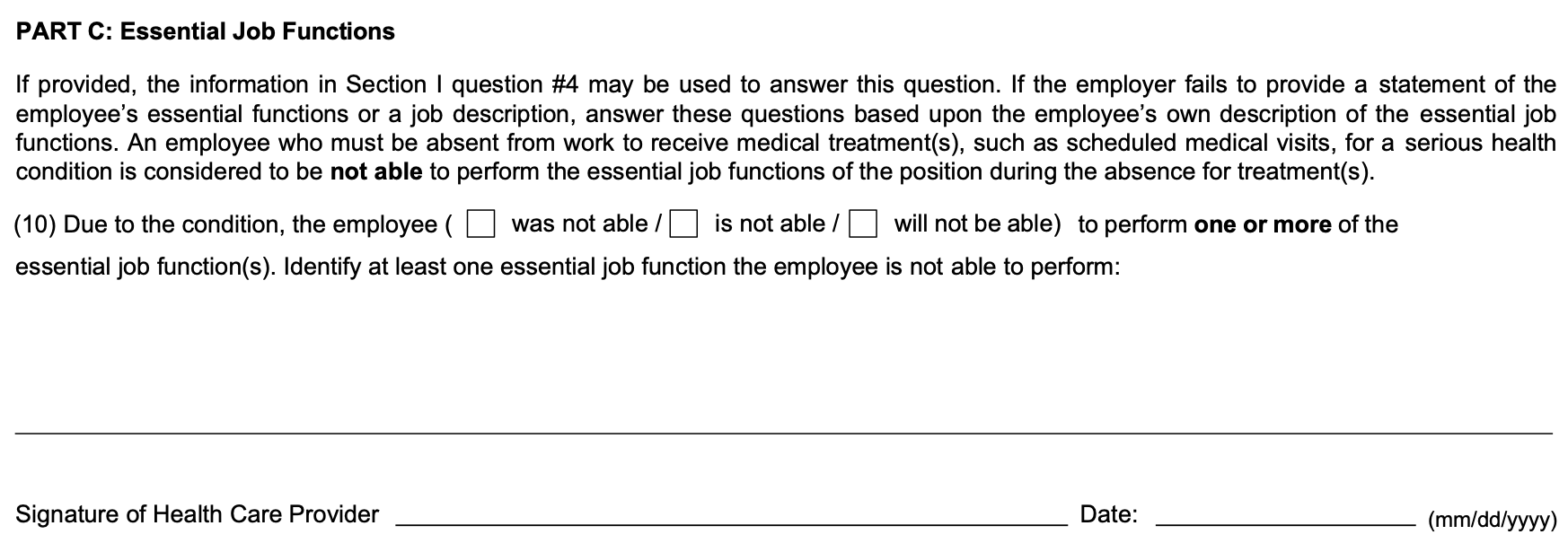
Part C: what part of the job can they not do?
Item 10 asks whether your patient is unable to do any core part of their job, and which part. If the employer described the job on page 1, answer against that description. If page 1 is blank, answer from what your patient told you the job involves. Being away for an appointment counts as being unable to do the job for that time. Then sign and date on page 4, with the same name you printed in Section II.
The form calls these “essential job functions”.
Why the WH‑380‑E FMLA form you completed is not accepted: the five usual suspects
- Item 2 says “unknown”, “lifetime” or “indeterminate”.
- Item 9 has how often but not how long, or the reverse.
- A box is ticked in item 3 but the lines under it (visit dates, admission date) are empty.
- Part C is blank, or says only “see above”.
- The signature does not match the printed name, or the date is missing.
When the fix is small, you often do not need a new form. If only a number changes, say flare-ups go from once a month to twice a month, in my experience HR will usually accept the change written on the original form: cross out the old answer with a single line, write the new one beside it, initial and date it, and send it back.
PatientPapers makes completing common medical form paperwork such as FMLA form WH‑380‑E and other forms faster and easier
Every “gotcha” on that list is something software can catch before you sign. I created PatientPapers to make it easier and faster for you to complete this paperwork, because as a physician myself, I understand the burden of this paperwork and wanted to do something to decrease it. It is my own product, built through the same company as this site, so weigh this accordingly. It turns the WH-380-E into a short set of plain questions, asks items 2 and 9 the way the law needs them answered, and fills in the real form for you. You review it before you sign. The pricing and the full description are on the PatientPapers site.
Open PatientPapers