Disabled parking placards
A patient asks for a parking placard at the end of the visit. In Missouri the statement is one page and takes two minutes, but it is a misdemeanor to sign it for a condition that is not on the printed list, and every state’s list is different.
- Worked example
- Missouri Form 1776, Physician’s Statement for Disabled License Plates or Placards
- Issued by
- Missouri Department of Revenue, Motor Vehicle Bureau
- Revision
- 08-2026
- Statute
- Section 301.142, RSMo
- Validity
- the statement is valid for 90 days
- Elsewhere
- 51 jurisdictions, 51 forms, and the criteria are not the same
Key points
- The form asks a legal question in medical terms. It prints the state’s list of qualifying conditions, and your signature says your patient meets at least one of them. A condition that is not on the list does not qualify, however real it is.
- Missouri’s walking limit is 50 feet without stopping to rest. Most states use 200 feet, a few use 100. The breathing and heart items are numbers and classes, not impressions.
- Temporary means a date. Leave it blank and Missouri issues 30 days; the date cannot be more than 180 days out, and the placard can be renewed once.
- Sign it yourself, and keep a copy in the chart with the examination that supports it. A stamped signature or a nurse signing for you is not accepted, and in Missouri signing for a condition that is not on the list is a Class B misdemeanor.
Before you start: what you are signing
A parking placard is issued by the state’s motor vehicle office, not by you, and the office does not examine anyone. It relies on one page: your statement that you examined your patient and found that they meet one of the conditions the state’s law lists. So the form is not asking whether your patient would benefit from parking closer. It is asking whether they fit a definition written by the legislature, and the definition is printed on the page.
My understanding is that Missouri’s Form 1776, revised August 2026, works like this. The statement is valid for 90 days, so the patient has to file it within that time. It is required for a new applicant and again every eighth year on renewal. You must sign it personally. You must keep a copy in the patient’s chart, with enough documentation to objectively confirm the condition, and your records are open to your licensing board to check that you did. And it is a Class B misdemeanor, up to a $500 fine or six months, to sign it for a person who does not meet a listed condition, or for a condition outside your licence’s scope. The rest of this page is that one form, block by block, and then what changes when you cross a state line.
The rule: Section 301.142, RSMo; the instructions printed on Form 1776.
The two blocks at the top: the patient, and you
The patient’s block asks for their name, their driver licence number or date of birth, their gender and their address. The form goes to the motor vehicle office, which matches it to the patient’s licence record, so the licence number is worth getting right; a form the office cannot match is a form that is not accepted.
Your block asks for your printed name, phone number, licence number and the state that issued it, and a tick for which kind of licensee you are: physician, advanced practice registered nurse, physician assistant, chiropractor, podiatrist, physical or occupational therapist, or optometrist. The licence number is how the state verifies you exist and checks the scope rule below. Leave it off and the form goes back to the patient to bring to you again.
The list is the law
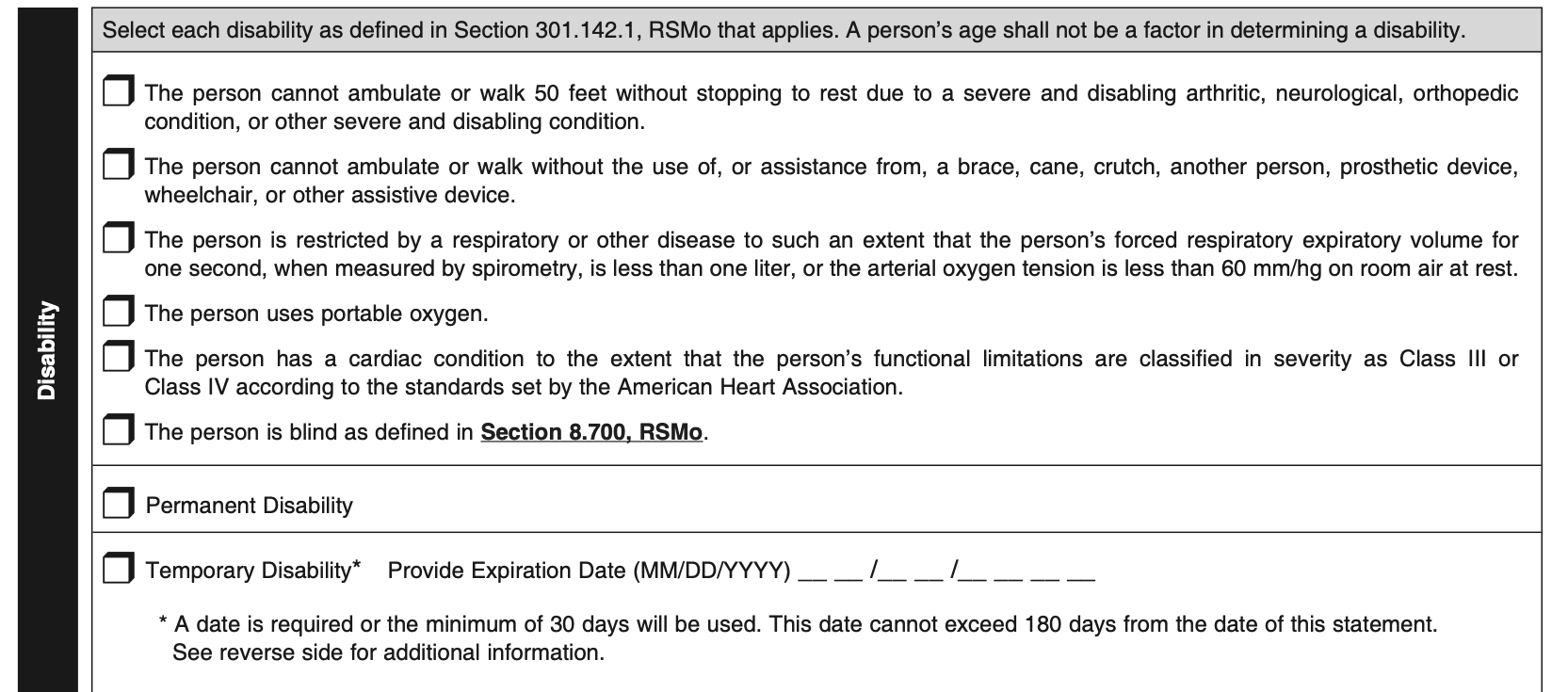
The Disability block opens with an instruction: select each disability, as defined in the statute, that applies, and a person’s age shall not be a factor. At least one box must be ticked. What follows is the whole of Missouri’s definition of “physically disabled” for this purpose, six items long.
Read the six before you reach for the pen. Two kinds of patient make this the box that matters: the one who plainly cannot walk across a car park but whose condition you would describe in words that are not on the list, and the one who is elderly and frail and asks because a neighbour has one. The first one qualifies under the 50-foot item if the walking limit is real; the second does not qualify on age, and the form says so. Nothing written in the margin adds a seventh item.
Cannot walk 50 feet without stopping, or cannot walk without help
The first item: the person cannot walk 50 feet without stopping to rest because of a severe and disabling arthritic, neurological, orthopedic or other severe and disabling condition. The second: the person cannot walk without a brace, cane, crutch, another person, a prosthetic device, a wheelchair or another assistive device. Most placards are issued under one of these two.
Tick the first when you have seen the limit or can support it from the chart: the patient who stops halfway down the corridor, the six-minute walk that ended early, the knee or the claudication that explains it. Write that observation in the note, because the form’s reverse side requires documentation that objectively confirms the condition. Tick the second when the aid is in the room; a patient who arrives with a walker meets it on sight. Fifty feet is a short distance, roughly the length of a bus, and it is the number that changes most at the state line: most states use 200 feet, a few use 100, so a patient who qualifies elsewhere may not qualify here.
The breathing numbers, and portable oxygen
The third item is a measurement: the person is so restricted by a respiratory or other disease that their forced expiratory volume in one second, on spirometry, is under one litre, or their arterial oxygen tension is under 60 mm Hg on room air at rest. A patient who gets short of breath on the stairs does not meet this item without one of those two numbers in the chart, and the state can ask to see it.
The fourth item is met on its own: the person uses portable oxygen. If the oxygen is prescribed and in use, tick it and move on; no measurement is asked for.
Class III or IV heart failure, and legal blindness
The fifth item is a heart condition whose functional limitation is Class III or IV by American Heart Association standards: symptoms with less than ordinary activity, or at rest. The class you assign in the note is the answer, so assign it there first and tick here second. The sixth item is blindness as defined in section 8.700 of Missouri’s statutes. Both are definitions you can point to in the chart, and both are outside a chiropractor’s, podiatrist’s or therapist’s scope, which is why the scope rule sits under the list.
Permanent
Tick permanent when the condition is not expected to improve: the amputation, the advanced heart failure, the neurological disease that progresses. Missouri asks for a fresh statement every eighth year on renewal, so permanent is reviewed, not forever, and you are not promising the state a lifetime. If you are unsure whether it will improve, that is what temporary is for.
Temporary, with a date
Tick temporary and write an expiration date. The form tells you the rules beside the box: if you leave the date blank, the state issues 30 days; the date cannot be more than 180 days from the date of your statement; and the placard can be renewed once, for another 180 days, on a new statement. Recovery after surgery is the usual case. Pick the date that matches the recovery, not the date of the next visit, because a placard that expires the week before your patient can walk to the shop sends them back for another form.
Signature, and who may sign
Missouri accepts a licensed physician, an advanced practice registered nurse, a physician assistant, a chiropractor, a podiatrist, a physical or occupational therapist, or an optometrist, and the form’s reverse side adds that a chiropractor, podiatrist or optometrist may sign only for conditions they are legally allowed to diagnose and treat. Whoever signs must sign personally; the form says twice that a stamped signature or a nurse’s signature is not acceptable.
Read the certification before you sign it. It says you have physically examined the person listed and determined that they are physically disabled for the reasons ticked above. That is a statement about an examination, not a favour to a patient you know well, and the misdemeanour paragraph sits directly above it. If the examination was some time ago and the condition may have changed, see the patient.
What changes at the state line
Every state and the District of Columbia has its own form, and the list printed on it is that state’s law, not Missouri’s. My understanding is that the walking distance is the number that changes most: 200 feet is the usual figure, a few states use 100, and Missouri’s 50 is among the strictest. After that, what changes is whether the state wants a diagnosis or only a tick, whether it offers a temporary placard and for how long, who may sign, whether it wants your licence number or the patient’s, and whether the statement goes in on paper or through a state portal. The one constant is a printed list and your signature under it, so the habit is the same everywhere: read the list on the form in front of you, tick only what you can support from the examination, and put the supporting note in the chart.
Why it is not accepted: the five usual suspects
- No disability box ticked, or a condition written in that is not on the list.
- Temporary ticked with no expiration date, or a date more than 180 days out.
- A stamped signature, or a nurse or assistant signing for you.
- Your licence number or its state missing, or the patient’s licence number wrong.
- A statement older than 90 days by the time the patient files it.
PatientPapers makes completing the parking placard form faster and easier, in every state
Every “gotcha” on that list is something software can catch before you sign. I created PatientPapers to make it easier and faster for you to complete this paperwork, because as a physician myself, I understand the burden of this paperwork and wanted to do something to decrease it. It is my own product, built through the same company as this site, so weigh this accordingly. It carries the placard statement for every state and the District of Columbia, asks the questions that state’s list actually asks, and fills in that state’s own form for you. You review it before you sign. The pricing and the full description are on the PatientPapers site.
Open PatientPapers