Total and Permanent Disability discharge
This is the one form on the pile that can erase a patient’s debt. Your part is five yes-or-no questions and a diagnosis, and the two questions that decide it have exact definitions printed above them.
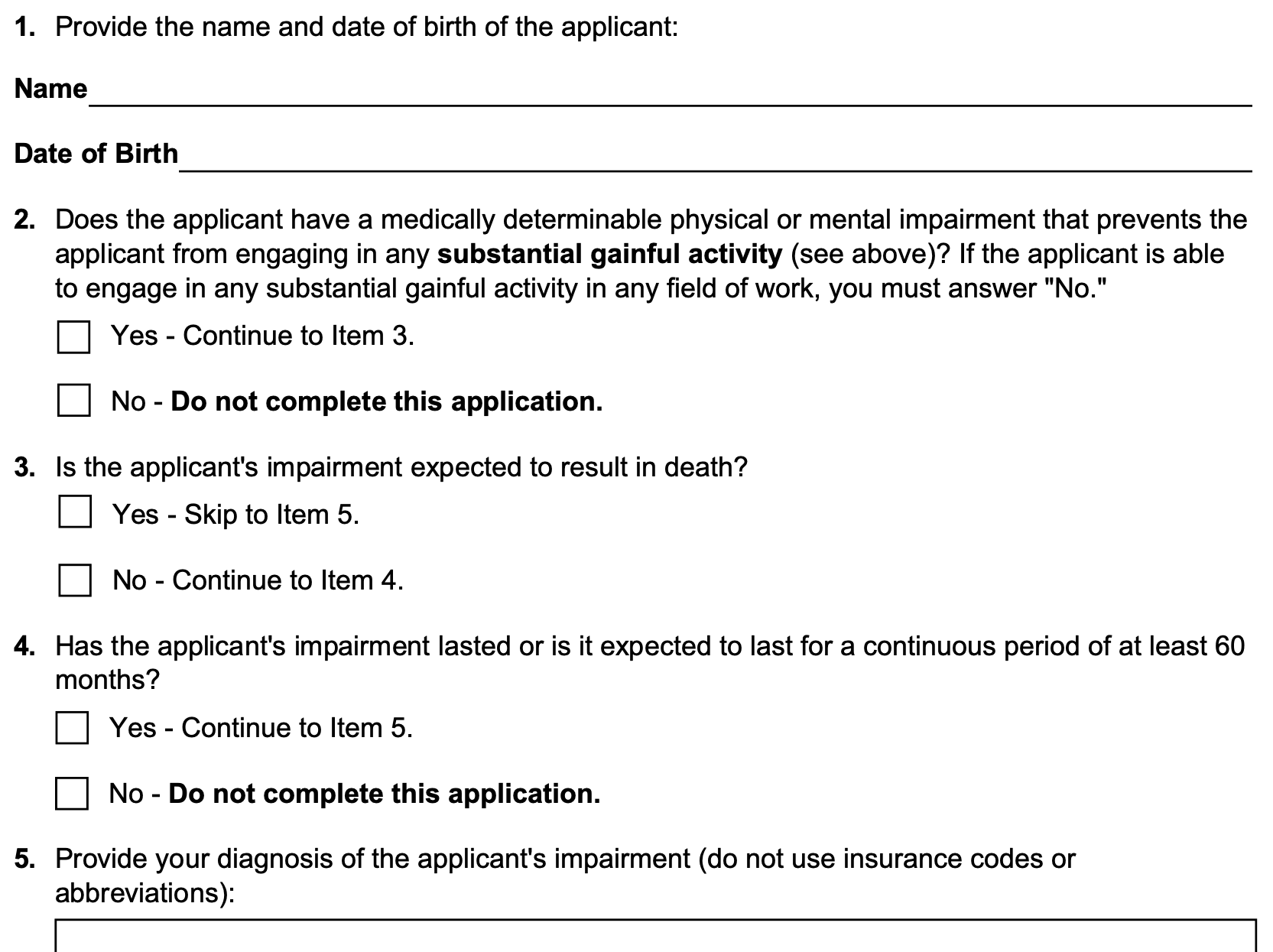
- Form
- Discharge Application: Total and Permanent Disability
- Issued by
- U.S. Department of Education, Federal Student Aid
- OMB control number
- 1845-0065, expiry printed as 02/28/2027
- Your part
- Section 6, pages 6 to 9
- Who may certify
- a doctor of medicine or osteopathy, nurse practitioner, physician assistant, or certified psychologist, licensed in a state
- Send
- pages 3 to 9 only, within 90 days of your signature; the applicant omits pages 10 to 19
Key points
- This is not a leave form or a disability claim. You are certifying that your patient cannot do any real work, in any field, because of a condition that will last at least five years or end their life. If that is true, the federal government cancels their student loans.
- Item 2 is the gate, and it is an any-work standard. If your patient could do any job that involves significant physical or mental activity for pay, the answer is no and the form tells you to stop.
- Item 5 wants the diagnosis in words. No insurance codes, no abbreviations, anywhere in Section 6.
- Items 7 to 11 are where the certification is won: sitting, standing, walking and lifting limits; daily living; what your patient can still do; social and behavioural limits. One specific limit beats a paragraph of “severe”.
- Your licence number and state are checked. A stamp is fine for the number and the address; the signature must be yours.
Before you start: what this form does, and who is asking
Federal Student Aid, part of the U.S. Department of Education, cancels a borrower’s federal student loans if the borrower has a total and permanent disability. There are three ways to show one: a Department of Veterans Affairs finding, a Social Security disability award that meets certain tests, or a certification from a clinician. Section 6 is that certification, and if your patient has brought you the form, it is because the first two routes are not open to them. Your four pages are the whole case.
The definition is printed at the top of page 6, and it is stricter than any form on this site. Your patient qualifies if a medically determinable physical or mental impairment prevents them from engaging in any substantial gainful activity, and that impairment is expected to result in death, has lasted a continuous 60 months, or is expected to last a continuous 60 months. Substantial gainful activity means work for pay or profit that involves significant physical or mental activity, or both. The form adds a note worth reading twice: this does not mean the applicant must be unable to work at all. It means they cannot do work at that level. So a patient who can manage a few hours of light, simple work does not necessarily fail item 2; a patient who could hold down a desk job in a field they have never worked in does.
Three things about how the Department handles it. The applicant must file within 90 days of the date beside your signature, so date it when you sign it. The Department may contact you for more information, or arrange its own examination at its expense. And a discharge is followed by three years of monitoring, so what you certify is checked later against what happens.
The section’s instructions ask for three habits: no abbreviations or insurance codes anywhere, print legibly, and initial any change you make. Give the completed section back to the applicant, or send it to the address in Section 1 yourself.
The rule: 34 C.F.R. § 685.213; the definition and instructions printed on page 6 of the application.
Item 1: the applicant’s name and date of birth
As they appear on the loan records. The borrower’s name and Social Security number also run along the top of every page of Section 6; the applicant fills those in, and you should check they are there, because a loose page 8 with no name on it is a page the Department cannot file.
Item 2: can they do any real work, in any field?
Does the applicant have a medically determinable physical or mental impairment that prevents them from engaging in any substantial gainful activity? The form then says it plainly: if the applicant is able to engage in any substantial gainful activity in any field of work, you must answer no. And under the no box, in bold: do not complete this application.
This is the opposite of the disability carrier’s form, which asks whether your patient can do their own job. Here the question is whether they can do any job that involves significant activity for pay, whether or not they have ever done it or could find it. Answer yes only when the honest answer to “is there any such job” is no, and be ready to say why in items 7 to 11. If your patient could work but not at their old job, the answer here is no, and the honest thing is to say so before the form is sent, because a yes that the rest of the section does not support is the usual reason the Department writes back to you.
Item 3: is it expected to result in death?
Yes skips the duration question and goes straight to the diagnosis; no continues to item 4. This asks about the expected course of the impairment, not about how ill the patient is today. A metastatic cancer, an advanced organ failure, a progressive neurological disease with a known course: yes. A serious condition that is expected to be survived: no, and on to the five-year question. A yes is a clinical judgement you should be able to defend from the chart if the Department asks.
Item 4: has it lasted, or will it last, five years without a break?
Has the impairment lasted, or is it expected to last, for a continuous period of at least 60 months? The onset date matters. An impairment with four years behind it and no prospect of improvement qualifies, because it is expected to reach five. An impairment that began last year and is expected to improve within five does not, and a no here, after a no at item 3, ends the application. The word is continuous: a condition that comes and goes, with periods of full function between, is a harder case, and the answer should rest on whether the impairment itself has been present throughout.
Items 5 and 6: the diagnosis, in words, and how severe
Item 5 asks for your diagnosis of the impairment, and says in the question itself: do not use insurance codes or abbreviations. Write it out in full, “chronic obstructive pulmonary disease” rather than “COPD”, because the reviewer is not a clinician and a code or an abbreviation is not a diagnosis to them. Item 6 asks for the severity, including the phase of the impairment if there is one: the stage, the class, the grade, whatever your specialty uses to say how far along it is.
Items 7 to 11: how the condition stops them working
Page 8 opens with the instruction that explains the whole section: explain in items 7 through 11 how the condition prevents the applicant from engaging in any substantial gainful activity in any field of work. This is where the certification is won or lost, because items 2 to 4 are yes-or-no and these are the reasons.
Item 7 is limitations on sitting, standing, walking or lifting; write numbers (“cannot stand for more than ten minutes; cannot lift more than five pounds; cannot sit for more than thirty minutes without lying down”). Item 8 is limitations on activities of daily living: dressing, bathing, cooking, driving, managing medication. Item 9 is residual functionality, meaning what your patient can still do; answer it honestly, because a blank here reads as an evasion and a modest answer supports item 2 better than nothing does. Item 10 is social and behavioural limitations, if any. Item 11 is a Global Assessment of Functioning score, for psychiatric conditions only.
Enter “N/A” where an item does not apply rather than leaving it blank, attach pages if you need them, and add the treatments and medications where they explain the picture; the form invites both. One specific limit is stronger than any adjective. “Profoundly limited” tells the reviewer nothing they can check; “cannot walk more than fifty feet without stopping” does.
The certification you are signing
Under item 11 the form prints what your signature means: that in your best professional judgement the applicant has a medically determinable impairment consistent with your answers in items 2 to 11, and that you understand an applicant who can currently do any substantial gainful activity in any field of work does not have a total and permanent disability as the form defines it. Read your items 7 to 11 back against item 2 before you sign. If they describe someone who could do some real work, item 2 should say no, and the form should not be completed.
Can you charge for this one?
My understanding is that California forbids a fee for forms that support a claim for a public benefit, and the statute names the federal student-loan disability discharge specifically, alongside Medi-Cal, Social Security disability and others. Elsewhere I found no rule either way for this form, which is not the same as permission; if the applicant is on Medicaid, assume you cannot charge them. The general rules are on the charging page.
The rule: Cal. Health & Safety Code § 123114.
Page 9: who you are
Tick your licensure: doctor of medicine, doctor of osteopathy, nurse practitioner, physician assistant, or certified psychologist at the independent practice level. Then the state where you are licensed and your professional licence number, which the form says is subject to verification and may be stamped. Then your signature, which the form says may not be stamped, the date, your name, your address (a stamp is fine), email, telephone and fax. If your licence is from a U.S. territory, attach a copy showing its expiry date.
The applicant sends pages 3 through 9 to the address in Section 1 and leaves out pages 10 to 19, and they have 90 days from your signature date to do it. A form dated the day you signed it, handed back the same day, gives them the whole window.
Why it is not accepted: the five usual suspects
- Item 2 is answered yes for an applicant who could work in some other field, and items 7 to 11 show it.
- Item 5 is an insurance code or an abbreviation.
- Items 7 to 11 are blank, or say only “disabled”.
- The licence number or the state is missing or does not verify, or the signature is a stamp.
- The applicant filed more than 90 days after your signature, sent pages 10 to 19, or left out pages 6 to 9.
PatientPapers makes completing the TPD discharge form faster and easier
Every “gotcha” on that list is something software can catch before you sign. I created PatientPapers to make it easier and faster for you to complete this paperwork, because as a physician myself, I understand the burden of this paperwork and wanted to do something to decrease it. It is my own product, built through the same company as this site, so weigh this accordingly. It asks the Section 6 questions against the printed definition, keeps the diagnosis in words, and fills in the real Federal Student Aid form for you. You review it before you sign. The pricing and the full description are on the PatientPapers site.
Open PatientPapers